Loading...
Please wait while we prepare your content
Please wait while we prepare your content
Service Detail
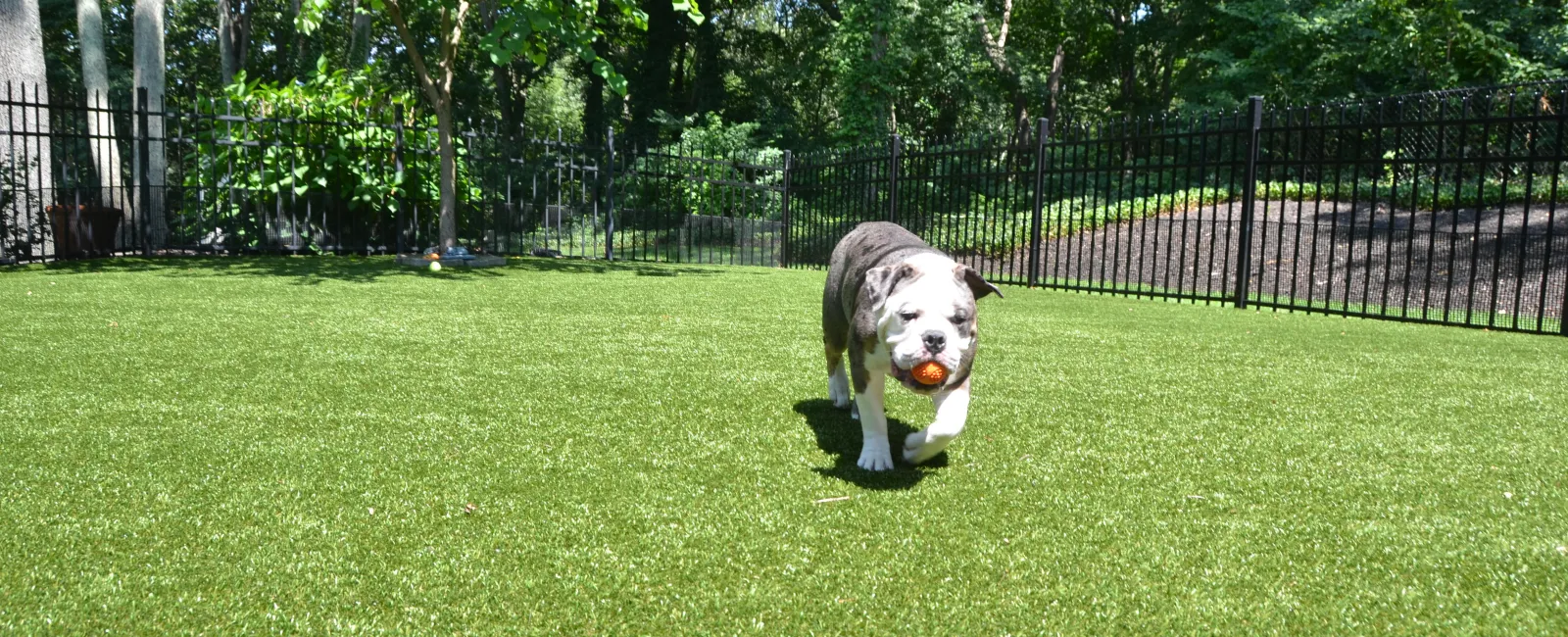
Dogs are hard on lawns. A seventy-pound Lab running the same path to the back fence twice a day creates a dirt rut inside three months on Bermuda. Urine kills St. Augustine in brown patches that take weeks to re-establish even with overseeding. During the wet winters that North Arlington clay absorbs slowly, back yards become muddy obstacle courses that track red clay into the house for four months. Pet owners in Wimbledon Oaks, Viridian, and the Pantego bungalow neighborhoods know this pattern intimately. Pet-friendly turf exists as a specific product category—not just standard residential synthetic grass marketed to dog owners, but turf engineered from the fiber down to handle urine chemistry, resist claw damage, and drain faster than standard installations. Turf Installation of Arlington selects and installs pet-specific synthetic grass products and pairs them with drainage systems and infill materials that actually manage the biological load a dog yard generates.
Overview
The product differences between standard residential turf and pet-specific turf show up at the fiber, the backing, and the infill level. Pet-grade fiber blends use a coarser filament that resists the lateral stress of a dog's claws without splaying or matting. The primary backing is typically a more permeable open-hole pattern that allows urine to flow through quickly rather than pooling at the surface between fiber rows. And the antimicrobial treatment baked into the fiber coating slows the bacterial decomposition cycle that generates ammonia odor under sustained use.
Infill selection matters more in pet applications than almost any other turf context. Standard silica sand infill holds odor compounds in the sand matrix over time. For pet yards, we transition to a zeolite-blended infill or a TPE-based antimicrobial product that does not retain ammonia compounds and can be periodically refreshed without full turf replacement. The zeolite mineral has a documented history in agricultural odor management—it is not a marketing claim but a measurable ion-exchange process that binds ammonium ions before they volatilize.
The drainage system under a pet turf installation also runs at a higher specification than standard residential. We use a flow-through drainage board below the base layer on pet applications, creating a secondary drainage path that supplements the compacted granite base. In North Arlington neighborhoods where clay subgrade is the norm, that secondary path matters. Without it, a heavy rain event after a week of pet use creates a saturated base layer that is slow to dry and holds odor compounds in solution.
Finally, proper sub-base preparation in pet applications includes antimicrobial treatment of the existing soil prior to base installation. This reduces the bacterial reservoir that can migrate upward through the base and into the infill over time.
Best fit
Turf Installation of Arlington installs pet-specific synthetic grass with antimicrobial infill and enhanced drainage for residential pet owners across Arlington, Mansfield, Grand Prairie, and Tarrant County. This service is often selected by Arlington homeowners and property managers who want better appearance consistency with less routine upkeep.
Typical scope focus
Service area
Arlington, Fort Worth, Grand Prairie, Mansfield, Bedford, and other nearby Tarrant County communities.
Browse LocationsScope & Process
Our pet turf work is spread across all of Arlington's residential zones. The North Arlington classic neighborhoods—particularly the established areas north of Division Street toward Green Oaks—tend to have single-family homes with larger back yards where multiple dogs have been running for years. These properties often need a soil remediation step before base installation because years of pet waste have created a bacterial load in the top four to six inches of ground that standard excavation alone does not fully address.
In South Arlington's Viridian community along Lamar Boulevard, pet turf projects often come from new homeowners who want to get ahead of lawn damage before their dogs have a chance to establish wear paths. Proactive installation on a Viridian lot is straightforward—the soils are more uniform, the drainage grade is designed into the subdivision, and the HOA has established precedent for synthetic turf approval that includes pet applications.
Lake Arlington properties bring their proximity to the lake and the associated higher water table into the drainage calculation. We assess groundwater conditions on lakeshore-adjacent lots before finalizing the drainage board specification, since a water table closer to the surface changes how quickly the secondary drainage layer can discharge.
For Pantego and Dalworthington Gardens pet owners—the two small cities that border Arlington's east side—the property sizes are typically smaller and the existing hardscape more established, which means edge work becomes more detailed. We handle transitions between the turf and existing concrete slabs, brick patios, and wood deck systems with care because those edges are visible from both the turf and hardscape sides.
Rental properties in the UTA corridor face a specific challenge: tenant dogs create heavy biological load without consistent cleanup, and when tenants turn over, landlords often discover a back yard that has absorbed years of urine and waste into clay soil. Our landlord-specific pet turf package addresses this scenario with a thorough soil treatment protocol before base installation.
Planning Factors
We review how pet-friendly turf installation should perform on the property, including how often the area is used, whether pets or children will be on it daily, and how visible the finished surface will be from the street or outdoor living areas.
Scope planning also covers base preparation, edge treatment, drainage expectations, and any transitions into concrete, pavers, planting beds, or other hardscape conditions around the installation zone in Arlington.
Before work begins, we map out access, staging, cleanup flow, and any scheduling constraints that affect the surface. That keeps installation cleaner and helps the finished turf feel intentional rather than patched into the space.
Included 01
Included 02
Included 03
Included 04
Included 05
Included 06
Included 07
Included 08
Why This Service
No synthetic turf is zero-maintenance when a dog is using it daily. The maintenance reality of pet turf is just dramatically simpler than the maintenance reality of natural grass under the same conditions. Solid waste removal is the same as it would be on natural grass—prompt pickup reduces the bacterial load and the odor contribution. Liquid waste management is where synthetic turf wins: proper drainage means urine passes through the surface and the base quickly, and a weekly rinse with a garden hose reactivates the zeolite ion exchange in the infill.
We provide specific maintenance guidance after every pet turf installation: the rinsing schedule, the enzyme cleaner protocol for high-use zones, and the infill refresh interval. For most residential dog yards with one or two medium-sized dogs, a thorough hose rinse twice a week and a quarterly enzyme treatment keeps the surface fresh. For properties with three or more dogs or a single large breed using a small area, we recommend a more frequent enzyme treatment and a professional infill refresh every eighteen months.
The annual professional maintenance service we offer includes an infill depth check, antimicrobial reapplication, fiber grooming, and drainage flow test. This visit catches any drainage performance changes before they create odor issues and extends the effective life of the installation considerably.
Available in nearby markets
If your property sits just outside Arlington, reach out with the address and we can confirm local coverage and scheduling.
FAQs
Antimicrobial infill slows bacterial growth that generates ammonia odor. Zeolite infill binds ammonium ions through an ion-exchange process rather than masking them. Combined with proper drainage and regular rinsing, the result is genuine odor reduction, not fragrance cover.
Pet-grade backing is more resistant to claw penetration than standard residential turf, but no turf is completely dig-proof for a persistent digger. We can add a reinforced perimeter anchoring method that discourages edge-digging, and the open-face fiber blend resists lateral stress better than soft-pile residential products.
For a property with one to two medium-sized dogs, a professional infill refresh every eighteen to twenty-four months maintains performance. Heavier use—three or more dogs or a large breed in a small area—may warrant an annual refresh visit.
Related Services
Turf Installation of Arlington delivers commercial synthetic grass for corporate campuses, sports venues, hotel courtyards, and retail centers throughout Tarrant County and the greater DFW corridor.
View serviceTurf Installation of Arlington replaces patchy Bermuda and dead St. Augustine with premium synthetic grass across all Arlington neighborhoods—North Arlington classic ranches, South Arlington Viridian and Lake Arlington properties, Wimbledon Oaks, Pantego, Dalworthington Gardens, and UTA-area rentals.
View serviceTurf Installation of Arlington designs and installs custom residential and commercial putting greens across Arlington, Mansfield, and the Tarrant County entertainment corridor.
View serviceTurf Installation of Arlington provides scheduled and one-time maintenance services for residential and commercial synthetic grass across Arlington, Tarrant County, and the DFW Entertainment District.
View serviceNext Step
Contact Turf Installation of Arlington for a pet turf consultation. We serve Arlington, Mansfield, Pantego, Dalworthington Gardens, Grand Prairie, and Tarrant County.
Request Estimate